Medicare for All
(WOJO's Version)
Medicare for All
(WOJO's Version)
Medicare for All
(WOJO's Version)
Healthcare in America is broken. Skyrocketing costs, unequal access, and a complex web of private insurance have left millions of families struggling to afford basic care. In Wisconsin’s 6th Congressional District, where rural communities and small businesses form the backbone of our economy, these challenges are felt deeply. Farmers, factory workers, and families are burdened by high premiums, deductibles, and out-of-pocket expenses, while many in rural areas face limited access to providers.
Medicare for All (WOJO’s version) offers a bold, practical solution. By providing universal health coverage through a single-payer system, we can ensure every resident of WI-06 and every American has access to quality healthcare without financial hardship. This policy is designed to reduce costs, improve access, and create a fairer system, all while ensuring that the working class sees net savings, even with targeted tax increases on the wealthy.
Under Medicare for All, the federal government will provide comprehensive health insurance to all eligible U.S. residents, replacing the current patchwork of public and private insurance. Coverage will include:
All essential medical services (doctor visits, hospital stays, preventive care)
Dental, vision, and mental health services
Long-term care for seniors and individuals with disabilities
Prescription drugs, with prices negotiated to match those in other developed nations
There will be no deductibles, copays, or premiums, ensuring that healthcare is truly accessible to all eligible individuals, regardless of income.
To address potential concerns about wait times or provider shortages, this plan includes investments in healthcare workforce development. This involves incentives for medical professionals to work in underserved rural areas like those in WI-06, such as loan forgiveness programs or increased funding for medical education in exchange for service commitments.
To make Medicare for All (WOJO’s Version) more fiscally responsible, eligibility for comprehensive coverage is limited to U.S. citizens and legal permanent residents (e.g., green card holders). This ensures that taxpayer-funded benefits prioritize those who are legally in our country and paying into the system, reducing overall costs and making the plan more palatable to a broad range of voters in districts like WI-06. By tying benefits to legal status, this policy creates an incentive for non-citizens to follow the correct pathways to citizenship or legal residency, addressing concerns with illegal immigration and ultimately increasing the tax base as more individuals formalize their status and contribute fully.
Coverage for Citizens and Legal Residents: All U.S. citizens and legal permanent residents, regardless of income or location, will receive full access to the comprehensive benefits outlined in this plan, with no deductibles, copays, or premiums.
Emergency Care for Non-Citizens: Undocumented immigrants and other non-legal residents will be guaranteed access to life-saving or emergency care under existing federal mandates like EMTALA, preventing public health crises and ensuring humane treatment. This maintains ethical standards without expanding full entitlements.
Fees for Non-Emergency Services: For non-emergency care, non-legal residents may access services but will be charged reasonable, sliding-scale fees based on income and ability to pay. This could generate an estimated $10–50 billion annually in additional revenue nationwide, helping to offset program costs while encouraging personal responsibility. Fees would be waived or reduced for refugees, asylees, or in humanitarian cases to avoid undue hardship.
This approach balances compassion with fiscal prudence, potentially saving tens of billions annually by focusing resources on those legally contributing, while avoiding the higher expenses of untreated conditions escalating to emergencies.
Lower Costs for Families and Businesses:
The average American family could save thousands annually on healthcare costs under Medicare for All, with total national savings estimated at $450 billion per year, according to a Yale University study published in The Lancet (2020). For WI-06’s median household income of approximately $74,000 (based on recent census data), this represents significant relief.
Small businesses and farmers, who often struggle with the high cost of providing health insurance, will no longer bear this burden, freeing up resources for growth and investment.
Improved Access in Rural Areas:
Rural communities in WI-06, such as those in Dodge, Fond du Lac, and Green Lake counties, will benefit from expanded provider networks and guaranteed access to care, addressing the shortage of rural healthcare providers.
Economic Relief for Seniors:
With approximately 16% of WI-06’s population aged 65 and over (based on 2023 census estimates), Medicare for All will provide comprehensive long-term care, reducing the financial strain on seniors and their families.
Public Health and Prevention:
By covering preventive care and reducing barriers to treatment, Medicare for All will improve public health outcomes, potentially preventing 68,000 unnecessary deaths annually nationwide, as estimated by the Yale study.
Job Creation and Economic Impact:
The savings and efficiencies from Medicare for All could lead to broader economic growth in WI-06 through reinvestment in local industries. By eliminating administrative waste in the private insurance sector, resources can be redirected to create jobs in healthcare delivery, infrastructure, and community services, boosting employment in rural areas and supporting the district's agricultural and manufacturing base.
Funding Medicare for All requires a thoughtful approach that prioritizes fairness and fiscal responsibility. Medicare for All (WOJO’s version) is funded through a combination of progressive tax increases on the wealthy, cuts to wasteful government programs (including defense and foreign aid), new revenue streams, and capturing savings from state and local governments. Importantly, low-income and middle-class families will see net savings, even with modest tax adjustments, while the wealthy contribute their fair share.
To fully fund the estimated $2 trillion net annual increase in federal spending (after redirecting existing federal healthcare funds), this plan incorporates a comprehensive set of revenue measures. These draw from established proposals, ensuring the total approaches or exceeds the required amount while minimizing economic disruption. By emphasizing cuts to wasteful spending, including in defense and foreign aid, we reduce reliance on tax increases.
Progressive Tax Increases on the Wealthy To ensure the burden does not fall on working families, tax increases will target high earners and the ultra-wealthy:
Income Tax Adjustments:
37% on income between $250,000 and $500,000
42% on income between $500,000 and $2 million
47% on income between $2 million and $10 million
50% on income above $10 million
Wealth Tax:
1% on net worth above $21 million, affecting only the top 0.1% of households
Closing Tax Loopholes:
Eliminate abusive tax practices, such as the Gingrich-Edwards loophole, ensuring high-income individuals pay their fair share of payroll taxes
These measures are projected to raise approximately $1.8 trillion over 10 years from income tax reforms and $1.3 trillion from the wealth tax, drawing from Sen. Bernie Sanders’s financing proposals.
Cuts to Wasteful Programs
Reduce ICE’s Budget:
By returning ICE’s budget to pre-2017 levels (around $6 billion annually), we can save approximately $2–3 billion per year, redirecting these funds to healthcare.
Eliminate Inefficient Federal Programs:
The Government Accountability Office (GAO) has identified numerous federal programs vulnerable to fraud and waste across its High Risk List, with potential savings of tens of billions annually through better oversight and reforms.
Target Wasteful Defense Spending:
By eliminating inefficiencies like over-budget programs (e.g., F-35 fighter jet overruns) and reducing unnecessary administrative redundancies and outdated systems, we can save $50–100 billion annually, as estimated by nonpartisan analyses from the Stimson Center and Quincy Institute. These smart cuts focus on waste, not veterans' benefits or core defenses, ensuring national security while prioritizing domestic needs.
Reevaluate and Reduce Foreign Aid:
Auditing and cutting non-essential foreign aid, such as economic assistance to non-strategic countries or duplicative programs. This could save $5–10 billion annually, based on recent congressional actions like the Rescissions Act of 2025 ($9 billion eliminated) and Senate-approved cuts ($8 billion). Aid to key allies would be preserved to avoid risking national security, while reductions target ineffective initiatives at the State Department.
New Revenue from Legalizing Marijuana
Federal Legalization and Taxation:
Legalizing marijuana federally could generate $8–10 billion annually in tax revenue, based on estimates from the Tax Foundation and other analyses.
In Wisconsin:
State-level legalization could bring in an additional $166 million annually, easing state budgets and indirectly supporting federal healthcare initiatives, per Wisconsin’s Legislative Fiscal Bureau.
Redirecting Existing Healthcare Spending
The federal government currently spends over $1.9 trillion annually on healthcare programs like Medicare ($1.03 trillion) and the federal share of Medicaid (around $600 billion). Under this policy, these funds will be consolidated into the Medicare for All system, reducing the net increase in federal spending to approximately $2 trillion annually, based on various economic analyses.
Additional Progressive Revenue Measures To bridge the funding gap, this plan includes the following targeted measures, focused on corporations, investors, and high-wealth individuals while promoting economic growth. With added savings from defense and foreign aid cuts, we can moderate some increases.
Corporate Tax Rate Increase to 25% (from 21%):
This moderate increase is projected to raise approximately $900 billion over 10 years ($90 billion annually), according to analyses from PwC and the Congressional Research Service. It ensures corporations pay a fairer share without stifling growth. Historical data shows U.S. corporate rates above 30% in past decades supported strong economies. Importantly, the elimination of employer-sponsored health insurance under Medicare for All will save businesses an average of $12,000–$15,000 per employee annually in benefits costs, more than offsetting the tax increase for many firms and allowing reinvestment in wages, innovation, and expansion.
Financial Transactions Tax (0.5% on stocks, 0.1% on bonds, 0.005% on derivatives):
This "Wall Street speculation tax" is estimated to generate $2.4 trillion over 10 years ($240 billion annually), per Sanders' proposals.
Tax Capital Gains and Dividends as Ordinary Income for High Earners:
Treating investment income like wages for those earning over $1 million would raise $2.7 trillion over 10 years ($270 billion annually).
Limit Tax Deductions for the Wealthy (e.g., cap itemized deductions at 28%):
This reform targets high-income tax shelters, generating $1.3 trillion over 10 years ($130 billion annually).
Offshore Tax Haven Crackdown (e.g., end deferral and strengthen anti-inversion rules):
Recapturing evaded corporate taxes could yield $1–1.5 trillion over 10 years ($100–150 billion annually).
Employer Payroll Tax Surcharge (6.2% on wages over $250,000):
Extending payroll taxes to high earners would raise $1 trillion over 10 years ($100 billion annually), building on the loophole closures.
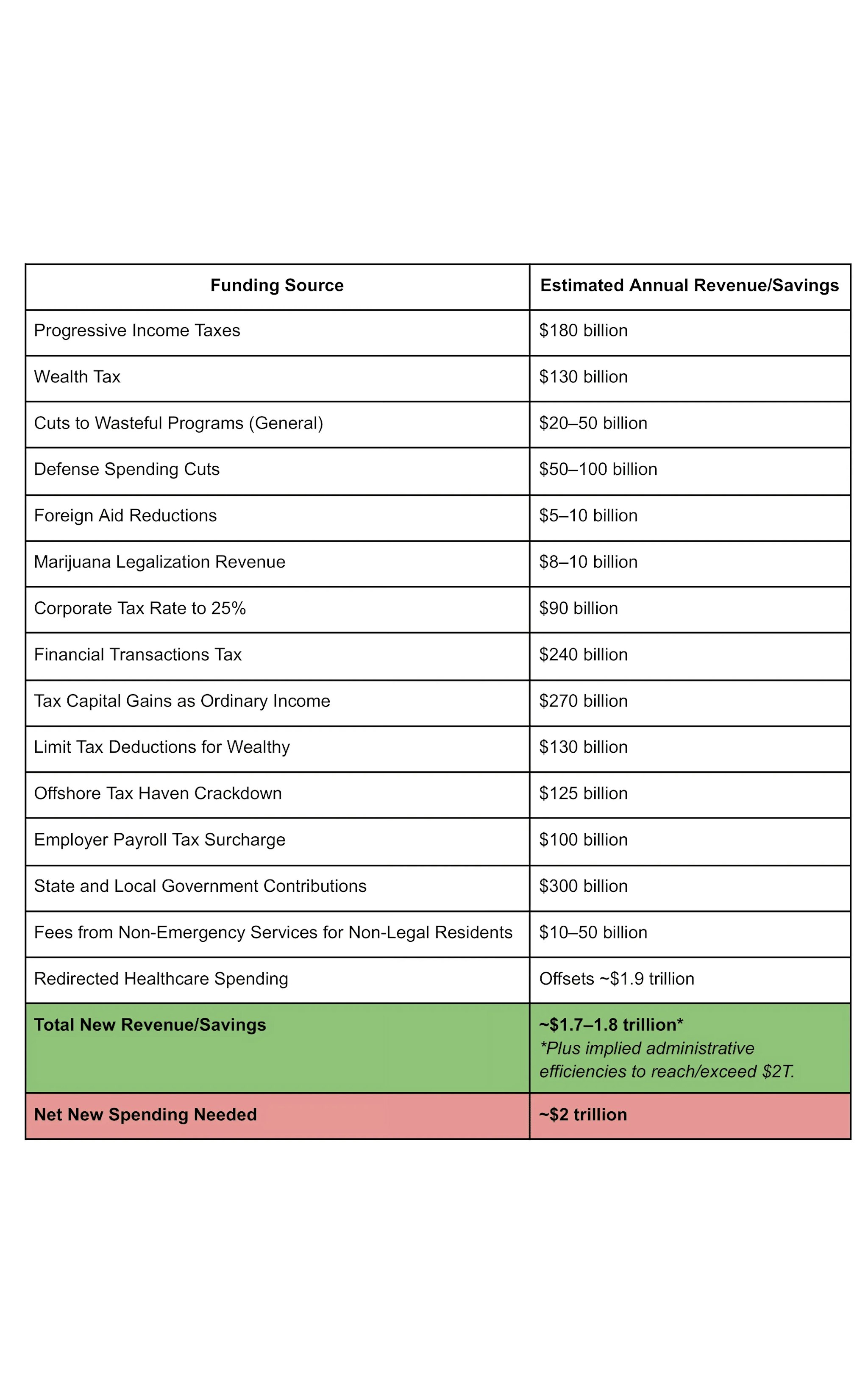
Under Medicare for All, state and local governments will experience significant relief from healthcare spending obligations, as the federal government assumes full responsibility for comprehensive coverage. Currently, states contribute approximately $280–350 billion annually to Medicaid (their share after federal matching), which represents a large portion of state budgets (often 20–30% of total spending). In Wisconsin, for example, Medicaid accounts for about 25% of the state budget. Local governments also bear costs for public employee health benefits and uncompensated care.
By shifting these responsibilities to the federal level, states and localities could save hundreds of billions nationwide annually. To ensure sustainable funding and shared responsibility, this plan proposes a "maintenance of effort" requirement, where states contribute a portion of their saved Medicaid funds back to the federal Medicare for All trust fund, estimated at around $300 billion annually nationwide (based on recent CMS and KFF data). This is not a new tax but a redirection of existing expenditures, calibrated to avoid burdening states (e.g., phased in with federal support for transition).
With these net savings, state and local governments could lower property taxes, providing direct relief to homeowners and renters in WI-06 or invest in vital services and infrastructure. For instance, Wisconsin could redirect funds to repair rural roads, expand broadband access, or support public education, fostering economic growth in underserved areas like Dodge and Fond du Lac counties. This approach not only funds M4A responsibly but also empowers states to address local priorities, creating a win-win for taxpayers.
A key advantage of Medicare for All is the dramatic reduction in administrative bureaucracy by eliminating the complex web of private insurance companies, which currently consume about 30% of healthcare dollars on overhead, profits, and paperwork. This shift to a single-payer system is projected to save hundreds of billions annually in administrative costs nationwide, freeing up resources and personnel.
To ease concerns about the logistics of verifying eligibility (e.g., citizenship or legal residency status), some of these saved administrative resources can be reallocated to handle verification processes efficiently. Existing federal staff from streamlined agencies, along with digital tools like secure online portals integrated with IRS and Social Security data, will ensure smooth implementation without net increases in bureaucracy or costs. This reallocation maintains the plan's efficiency while upholding fair eligibility standards.
Despite targeted tax increases, low-income and middle-class families will see significant net savings under this policy:
Healthcare Cost Elimination:
Families will no longer pay premiums, deductibles, or out-of-pocket costs, saving thousands per year.
Progressive Tax Structure:
Families earning less than $250,000 will face minimal to no tax increases. For example, a family earning $50,000 could see their effective tax rate increase by only 6% (about $3,000), while saving the full $15,000 they currently spend on healthcare (including employer contributions). This results in a net gain of $12,000 annually, as outlined by economists Emmanuel Saez and Gabriel Zucman.
Wage Increases:
Employers will no longer need to provide health insurance, potentially leading to wage increases for workers, further offsetting any tax adjustments.
Fiscal Responsibility:
By cutting wasteful spending and targeting taxes on the wealthy, this policy aligns with values of efficiency and fairness, putting America first by prioritizing domestic healthcare over ineffective overseas programs.
Rural Healthcare Access:
Medicare for All will strengthen rural healthcare infrastructure, ensuring providers are adequately compensated and incentivized to serve underserved areas.
Support for Farmers and Small Businesses:
Eliminating the burden of providing health insurance will allow small businesses and farmers to reinvest in their operations, boosting the local economy.
Reducing Bureaucracy and Promoting Personal Responsibility:
This plan reduces bureaucracy by eliminating private insurers' administrative overhead (estimated at 30% of costs) and promotes personal responsibility through incentives for preventive care, encouraging healthier lifestyles and reducing long-term costs.
National Security:
Cuts to defense and foreign aid focus on verifiable waste (e.g., failed Pentagon audits and non-strategic aid), not essential programs. Aid to essential allies remains protected to maintain security, while reductions target inefficiencies, echoing 2025 actions like the Rescissions Act and executive reevaluations that have broad support.
While the core of Medicare for All (WOJO’s Version) focuses on immediate reforms to provide universal coverage and control costs, emerging technologies like artificial intelligence (AI) offer promising opportunities for further optimization. These are not part of the current proposal but are worth exploring through pilot programs and stakeholder feedback to ensure they align with our goals of fiscal responsibility, equity, and technological competitiveness.
AI for Cost Reduction and Waste Prevention: AI tools, such as predictive algorithms and decision-support systems, could analyze patient data to identify and prevent unnecessary care, such as redundant tests or low-value procedures. This might reduce healthcare waste by 20-30%, potentially saving $200-360 billion annually nationwide by guiding patients toward appropriate self-care, telehealth, or preventive measures. In WI-06, this could mean smarter triage for rural residents, avoiding costly ER visits for minor issues.
Economic Partnerships and Benefits: Integrating AI could foster public-private partnerships with tech firms to develop customized tools, like diagnostic AI for underserved areas. This would create jobs in tech-health sectors, attract investments to Wisconsin, and boost local economies through R&D and training programs. Globally, such innovations would keep the U.S. competitive, with breakthroughs in AI-driven healthcare potentially spilling over to other fields like agriculture (e.g., predictive analytics for farm worker health) or manufacturing.
Phased Implementation and Safeguards: To address concerns, any AI integration would be phased in, starting with voluntary pilots in select regions to test efficacy and gather data. This gradual approach minimizes risks and allows for adjustments based on real-world outcomes. Critically, data privacy and HIPAA compliance would remain paramount. AI systems would use anonymized, encrypted data with strict ethical guidelines, independent audits, and patient consent protocols to prevent breaches or biases. Equity measures would ensure AI benefits all demographics, avoiding disparities in rural or low-income communities.
Exploring AI in this way could enhance the plan's long-term sustainability, but it requires careful collaboration with experts, regulators, and voters to balance innovation with protection. Feedback on this idea is especially welcome as we refine the proposal.
Medicare for All (WOJO’s Version) is a transformative yet practical solution to America’s healthcare crisis. By providing universal coverage, reducing costs, and ensuring fairness in funding, this policy will deliver tangible benefits to the residents of Wisconsin’s 6th District. It is a plan that puts people first, offering relief to families, supporting small businesses, and strengthening rural communities while maintaining fiscal responsibility and progressive values.
We welcome feedback from voters to refine this proposal further.
Works Cited
Galvani, Alison P., et al. "Improving the prognosis of health care in the USA." The Lancet, vol. 395, no. 10223, 2020, pp. 524-533.
U.S. Census Bureau. "American Community Survey: Congressional District 6, WI." Census Reporter, 2023. Accessed December 8, 2025.
Sanders, Bernie. "Options to Finance Medicare for All." Bernie Sanders Senate Website, 2019.
U.S. Government Accountability Office. "High Risk List." GAO, 2025.
Tax Foundation. "Cannabis Tax Revenue & Nationwide Cannabis Tax Policy Blueprint." Tax Foundation, 2023.
Wisconsin Legislative Fiscal Bureau. "The State of Cannabis in Wisconsin." 2025.
Centers for Medicare & Medicaid Services. "National Health Expenditure Data: NHE Fact Sheet." CMS, 2025.
Saez, Emmanuel, and Gabriel Zucman. "Financing Medicare for All." University of California, Berkeley, 2020.
Committee for a Responsible Federal Budget. "How Much Will Medicare for All Cost?" CRFB, 2019.
PwC. "Biden's FY2025 Budget Again Calls for Corporate and Individual Tax Increases." PwC, 2024.
Congressional Research Service. "Trends and Proposals for Corporate Tax Revenue." CRS, 2024.
KFF. "Federal and State Share of Medicaid Spending." KFF, 2025.
MACPAC. "Spending." MACPAC, 2025.
Stimson Center. "Defense Budget Savings Opportunities." Stimson Center, 2025.
Quincy Institute for Responsible Statecraft. "Reforming U.S. Defense Spending." Quincy Institute, 2025.